What VALORANT Champions Shanghai Group Stage Day 8 Delivered for the 2026 Title Race
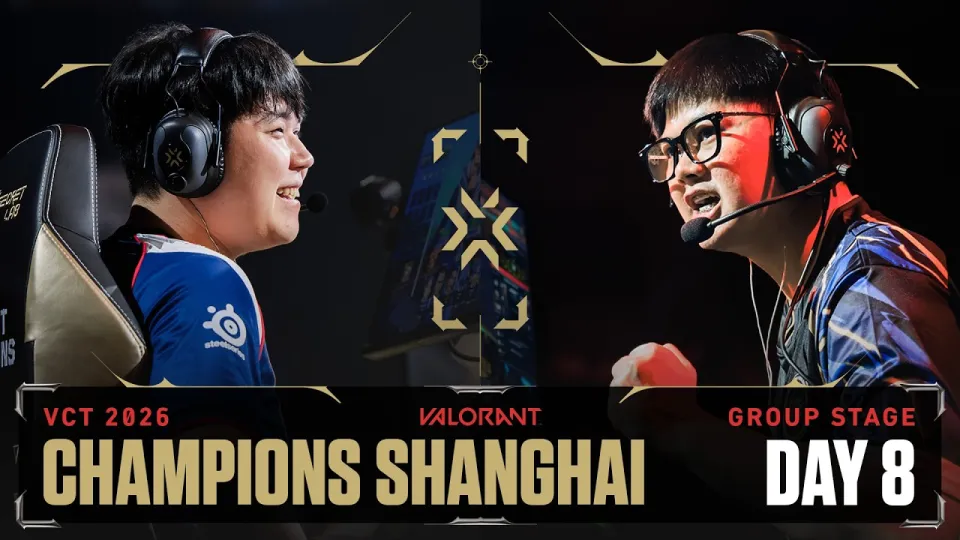
Video: VALORANT Champions Shanghai — Group Stage — Day 8
Want articles like this for your own video to promote it on YouTube and Google? Order them through the Telegram bot @sat_sit_bot. It writes articles around your video, embeds the video and publishes them on popular niche websites (no ads). Your first 50 articles are free.
· based on the channel VALORANT Champions Tour
VALORANT Champions Shanghai is the final stop of the 2026 VCT season, and group stage Day 8 decided which teams still had a path to the world title. The day's headline series, T1 vs JD Gaming, ended the run of the tournament's host region and locked in the last playoff picture. Follow the official channel at VALORANT Esports on X for brackets, schedules and live updates as the bracket fills out.
The Day 8 broadcast, published by the VALORANT Champions Tour on October 2, carried two complete matches and a technical pause, and it is the cleanest snapshot of where the meta sits heading into the playoff stage. Sixteen teams from Americas, CN, EMEA and Pacific arrived in Shanghai; by the end of the day, the field had narrowed to the names that will actually contest the trophy.
What the VALORANT Champions Shanghai format demands from sixteen teams
Shanghai is the season-ending world championship, not a regional qualifier, so every group stage match carries elimination weight. The event runs from September 24 to October 18, with sixteen invited teams split across the four international leagues. Groups are played in a round-robin, and only the top seeds advance to a double-elimination playoff bracket, which means a single bad map can end a year of circuit points.
That structure explains why Day 8 mattered so much. With the group stage closing, teams no longer had the luxury of dropping a series and recovering later. The format rewards depth: rosters need a reliable map pool, a functioning secondary caller and at least one player who can take over a half on a duelist. Sides that arrived with a narrow comfort pick were already exposed before the final day of groups.
T1 vs JD Gaming turned on one thrown lead
JD Gaming's series against T1 is the match most viewers will remember from Day 8, and it hinged on map one. JDG built a 6-11 advantage and looked set to take the opener, a lead that would have put a Chinese team in position to win a map against elite international opposition. Instead they lost the map, and the series tilted permanently.
The pattern repeated in miniature across the night. JDG stayed competitive on the first two maps and then collapsed on the decider, which is the classic symptom of a roster that has prepared for specific opponents rather than for a long series. T1, by contrast, adjusted between maps, moved utility assignments around and let their star rifler carry the middle rounds. The result was a 2-1 series and an exit for the host region's last remaining hope.
Viewers also flagged a recurring officiating question from the broadcast: a sequence where three bullets appeared to connect with an Omen model but only two registered as damage. Riot's server-side hit registration and the spectator client's interpolation can produce exactly that visual mismatch, which is why tournament officials review demos rather than broadcast frames.
Why all four Chinese teams went out before the playoffs
No CN representative reached the playoff bracket in Shanghai, and the reaction online split into two camps. One argument holds that the region simply was not ready for the pace of international competition; the other points out that CN teams receive direct VCT slots and therefore carry an obligation to convert them into results.
The honest answer sits between the two. Chinese rosters have the mechanical talent, and JDG's 6-11 lead on map one proves they can build advantages against top-tier opposition. What they lacked was closing discipline: converting a lead into a map win requires a different set of habits than building one, and those habits are built through repeated deep runs at international events. A single strong group stage day does not replace that experience.
There is also a structural factor. The regional circuit in CN is younger and shallower than the EMEA or Pacific ladders, so teams get fewer chances to practise against the specific pace and utility timing that Shanghai demands. Merging back into a wider APAC structure would raise the weekly difficulty, but it would also reduce the guaranteed slots that currently fund these rosters. Neither option is free.
The small moments that shaped the day's narrative
Two details from the broadcast picked up more discussion than the scoreline. The first was a Crown being silenced at a critical moment, a play that removed a team's ultimate economy at exactly the wrong time and, according to viewers, was the most satisfying sequence of the match. Ultimate economy is the quiet currency of VALORANT at this level; denying a Crown or a comparable global ability often decides a half more decisively than a highlight frag.
The second was the venue itself. Multiple viewers compared the Shanghai stage to a library, and the observation is not just about atmosphere. A quiet crowd changes how players communicate, how they call rotations and how much they rely on audio cues. Teams that practise in loud LAN environments sometimes struggle when the room goes silent, and the on-stage comms become the only information channel left.
There was also a roster question that surfaced in chat: Munchkin being fielded on a duelist. Coaches use group stage matches to test role flexibility before the bracket, and a controller or initiator player taking a duelist slot is a common way to probe whether a team can survive a map veto. It rarely means the role change is permanent.
What Day 8 tells us about the 2026 world title race
The 2026 season has already produced two different Masters champions, which is the clearest signal that the old hierarchy has loosened. New contenders have arrived, expectations have been broken, and the teams that looked untouchable in past years are now beatable on any given map.
Shanghai is where that shift gets settled. The remaining playoff teams share three traits: a deep map pool, at least two players who can take over a half, and a coaching staff willing to change the plan mid-series. The eliminated sides, including all four CN representatives, generally had one of the three.
For anyone tracking the bracket, the practical takeaway is to watch map vetoes rather than scorelines. A team that wins the veto usually wins the series at this stage, because the margins between rosters are now small enough that preparation outweighs raw aim.
Useful links from the broadcast
- Official VALORANT Esports updates: https://x.com/valorantesports
- Facebook: https://www.facebook.com/ValorantEsports/
- Instagram: https://www.instagram.com/valorantesports/
- TikTok: https://www.tiktok.com/@valorantesports
- Twitch: https://www.twitch.tv/valorant
Where the Shanghai group stage leaves the season
Day 8 closed the group stage with the host region eliminated and the bracket reduced to teams that can survive a long series. T1's comeback over JD Gaming was the defining result, but the broader story is a 2026 season in which no single region dominates and every playoff seed is genuinely live. The VALORANT Champions Tour, which produced this Day 8 broadcast, will carry the remaining matches through October 18, and the playoff rounds are where the title will actually be decided. For schedules, brackets and live coverage, follow VALORANT Esports on X and check the official site before each match day.
Key takeaways
- VALORANT Champions Shanghai runs September 24 to October 18 with 16 teams from Americas, CN, EMEA and Pacific.
- Day 8 of the group stage featured T1 vs JD Gaming and a full three-map series.
- All four Chinese representatives were eliminated before the playoff bracket.
- JD Gaming let a 6-11 lead slip on map one against T1, a result that decided the series.
- The broadcast ran two full matches plus a tech pause, with the second series going the distance.
Questions & answers
Did any Chinese team make the playoffs at VALORANT Champions Shanghai?
No. All four CN representatives were eliminated during the group stage, which ended on Day 8. JD Gaming came closest, holding a 6-11 lead on map one against T1 before losing the series 2-1. It was the region's best chance at a map win against top international opposition.
Why did JD Gaming lose to T1 after leading 6-11?
JDG built the lead through disciplined early-round execution but could not convert it into a map win. T1 adjusted their utility usage between maps, won the mid-round economy battles and closed out the decider comfortably. The pattern of staying close on early maps and collapsing on the third is typical of teams with a narrow prepared map pool.
What does it mean when a Crown gets silenced in VALORANT?
Silencing a Crown removes a team's ability to use that ultimate at the moment they planned to execute. At this level, ultimate economy often decides a half more than individual frags, because a single global ability can break a defensive setup or secure a retake. Denying it forces the opponent to re-plan mid-round.
Why did viewers compare the Shanghai venue to a library?
The crowd was noticeably quiet during parts of the broadcast, and several viewers joked that the stage felt like a library. A silent arena changes player communication, since teams can no longer rely on crowd noise to mask calls, and it makes on-stage comms the only information channel. Some rosters adapt to that faster than others.
Source: VALORANT Champions Shanghai — Group Stage — Day 8 · Markdown version